
CQRS (Command and Query Responsibility Segregation) is an architectural pattern that separates an application’s command (aka writes) and query (aka reads) operations into distinct components. The main idea is to use different models for reading (queries) and writing (commands) data, thus optimizing the system for each operation’s specific requirements. In a traditional monolithic architecture, the same data model is often used for both reads and writes. This can lead to inefficiencies, as read-heavy and write-heavy operations have different performance characteristics and scalability needs. CQRS addresses this by introducing two separate models: the Command Model and the Query Model.
Command Model
- Responsible for handling write operations or commands that modify the application’s state.
- Represents the “single source of truth” for data changes.
- Can use a domain-driven design (DDD) approach to encapsulate business logic and enforce invariants.
Query Model
- Handles read operations or queries that retrieve data without modifying the application’s state.
- Optimized for fast and efficient data retrieval based on specific use cases.
- Can be implemented using a read-only replica of the data store or specialized data structures.
Below architecture diagram shows the basic CQRS pattern
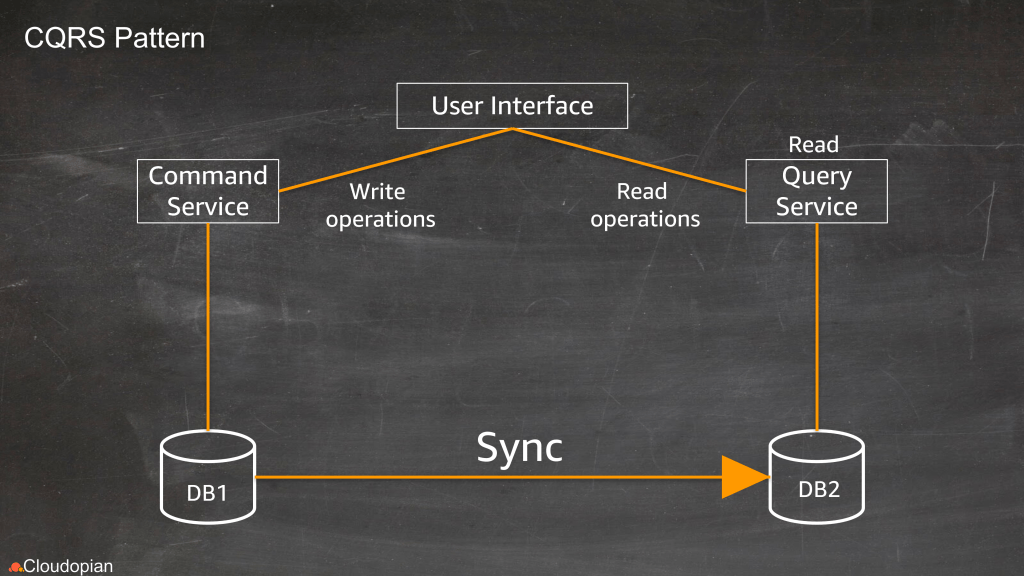
In the actual implementation, there may be more components involved. For example, the command service will write a queue and immediately return the success message to the writer while a background process slowly writes the content to the database.

Some Benefits of CQRS
- Scalability: Allows independent scaling of read and write components based on their respective workloads.
- Performance: Optimizes data retrieval by tailoring the query model to specific read requirements.
- Flexibility: Enables the evolution of the command and query models independently, allowing system enhancements without affecting each other.
- Complex Query Support: Simplifies complex read operations by designing the query model to address specific needs.
Some Challenges of CQRS
- Eventual Consistency: The separation of models may lead to eventual consistency between the read and write sides, requiring developers to handle potential inconsistencies in the application.
- Increased Complexity: Implementing and maintaining separate command and query models can add complexity to the application.
In conclusion, the CQRS pattern is a valuable architectural approach for systems that have distinct read and write requirements. By segregating command and query operations, CQRS helps optimize performance, scalability, and flexibility in modern applications.